

Can You Repair Flood Damaged Dodge Trucks
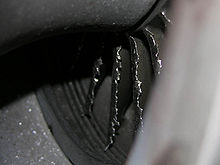
Foreign object harm to the compressor blades of a Honeywell LTS101 turboshaft engine on a Bell 222, caused by a small commodities that passed through the protective inlet screen

FOD deflection system on a PT6T installed on a Bell 412. Air enters from upper right, and pure air follows the curved ramp downwardly to the compressor inlet (besides covered by a screen). Any debris being sucked in will have plenty momentum that information technology will not brand such a precipitous bend, and volition hitting the screen on the upper left, and will be carried out to the left, getting blown overboard.
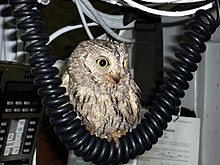
Potential strange object debris (in this case, a Scops owl) establish in the wheel well of an F/A-eighteen Hornet on a US aircraft carrier
In aviation and aerospace, foreign object damage (FOD), is any particle or substance, conflicting to an aircraft or system, which could potentially crusade damage.[1]
External FOD hazards include bird strikes, hail, water ice, sandstorms, ash-clouds or objects left on the runway. Internal FOD hazards include items left in the cockpit that interfere with flight safety by getting tangled in control cables, jam moving parts or curt-out electrical connections.
The term FOD is used to describe both the foreign objects themselves, and any damage attributed to them.
Examples [edit]
FOD tin be internal or external.[2] [3] [four]
Internal FOD is impairment or hazards acquired by foreign objects inside the aircraft. For example, cockpit FOD is a state of affairs where an item gets loose in the cockpit and jams or restricts the functioning of the controls. Tool FOD is a serious gamble caused past tools left inside the shipping after manufacturing or servicing. Tools or other items can get tangled in command cables, jam moving parts, brusk out electric connections, or otherwise interfere with safe flight. Aircraft maintenance teams normally have strict tool control procedures including toolbox inventories to make sure all tools take been removed from an aircraft before information technology is released for flying. Tools used during manufacturing are tagged with a serial number so if they are found they can be traced.
Examples of FOD include:[five]
- Aircraft parts, rocks, broken pavement, ramp equipment.
- Parts from ground vehicles
- Garbage, maintenance tools, etc. mistakenly or purposely deposited on tarmac and/or track surfaces.
- Hail: tin break windshields and impairment or stop engines.
- Ice on the wings, propellers, or engine intakes
- Bird collisions with engines or other sensitive parts of the shipping.
- Dust or ash clogging the air intakes (equally in sandstorms in desert operating conditions or ash clouds in volcanic eruptions). For helicopters, this is also a major problem during a brownout.
- Tools, bolts, metal shavings, lockwire, etc. mistakenly left behind within aircraft during the manufacturing process or maintenance.
All aircraft may occasionally lose minor parts during takeoff and landing. These parts remain on the runway and can cause damage to tires of other shipping, hit the fuselage or windshield/canopy, or get sucked upwardly into an engine. Although airport ground crews regularly clean upward runways, the crash of Air French republic Flight 4590 demonstrated that accidents tin can withal occur: in that case, the crash was attributed to titanium droppings dropped by a Continental DC-10 flying that had departed simply iv minutes earlier.

On shipping carriers, as well as military and some civilian airfields, sweeps are conducted before flight operations begin. A line of crewmen walk shoulder to shoulder (frequently referred to as a FOD Walk) along the flight operations surfaces, searching for and removing whatever strange objects.
Jet engine pattern and FOD [edit]
Modern jet engines can suffer major damage from even small objects being sucked into the engine. The FAA (Federal Aviation Assistants) requires that all engine types laissez passer a test which includes firing a fresh chicken (dead, but not frozen) into a running jet engine from a small-scale cannon. The engine does non take to remain functional subsequently the test, but information technology must not cause significant damage to the residue of the shipping. Thus, if the bird strike causes information technology to "throw a blade" (intermission apart in a mode where parts fly off at loftier speed), doing and then must not cause loss of the aircraft.[six]
Engine and airframe designs which avoid FOD [edit]
Some military machine aircraft[ commendation needed ] [ which? ]had a unique design to prevent FOD from damaging the engine. The pattern included an S-shaped curve in the airflow, so that air entered the inlet, was bent back towards the front of the plane, and bent back over again towards the back before inbound the engine. At the dorsum of the offset bend a potent spring held a door shut. Any strange object flying in the intake flew in, hitting the door, opened it, flew through, and then exited the aircraft. Thus, merely minor objects swept up by the air could enter the engine. This design did indeed forestall FOD problems, just the constriction and drag induced by the angle of the airflow reduced the engine's constructive ability, and thus the design was not repeated.
A like approach is used on many turboshaft-powered helicopters, such equally the Mi-24, which use a "vortex-type" or "centrifugal" intake, in which the air is forced to flow through a spiral path before entering the engine; the heavier dust and other debris are forced outwards, where it is separated from the airflow before it enters the engine inlet.
The Russian Mikoyan MiG-29 and Sukhoi Su-27 fighters have a special intake design to forbid ingestion of FOD during take-off from rough airfields. The main air intakes could be closed with mesh doors and special inlets on the top of the intakes temporarily opened. This would allow enough airflow to the engine for have-off but reduced the chances of the engine sucking up objects from the ground.
Another interesting pattern to minimize the risk of FOD is the Antonov An-74 which has a very high placement of the engines.
Boeing offered a gravel rails kit for early 737s that allows the airplane to be used from unimproved and gravel runways, in spite of having very low-slung engines. This kit included gravel deflectors on the landing gear; foldaway lights on the lesser of the plane; and screens that prevented gravel, which would enter the open wheelwells when the gear was extended, from striking disquisitional components. The kit also included vortex dissipators, devices which would reduce the airflow into the engine from the lesser then every bit to reduce the likelihood of ingesting gravel.
Airbus engineers are investigating a novel approach to reducing FOD. By developing, in conjunction with State of israel Aerospace Industries, the Taxibot, a tractor controlled by the pilot, aircraft will non need to use jet engines while taxiing, and therefore they will non be vulnerable to FOD on aprons or taxiways.[vii]
FOD harm examples [edit]
Vehicle tire rails-in [edit]
Debris is often trapped in the treads of tires from vehicles coming onto an airfield. Types of debris trapped in a vehicle tire tin include rocks, mud, stones, loose hardware (screws, washers, bolts, ect.) and many other forms of small materials. These can exist crew & fuel trucks, maintenance vehicles and many others that inadvertently bring and deposit debris around a flight line. These types of FOD are very difficult to track and manage in one case they are introduced into the airfield. The debris can and so easily exist picked upwardly past jet engine intake, engine blast and prop/rotor typhoon. This material, once loose around operational aircraft, can lead to serious safety concerns including personnel injury and equipment/belongings impairment.
Runway debris [edit]
The crash of a Concorde, Air France Flight 4590, at Charles de Gaulle Airport near Paris on 25 July 2000 was acquired by FOD; in this example a piece of titanium debris on the runway which had been part of a thrust reverser that had fallen from a Continental Airlines McDonnell Douglas DC-10 during takeoff well-nigh four minutes earlier. All 100 passengers and ix crew on board the flight, also as four people on the footing, were killed.
A Gates Learjet 36A, registration number N527PA, was taking off from Newport News/Williamsburg International Airport in Virginia on March 26, 2007, when the coiffure heard a loud "pop". Aborting the takeoff, the crew tried to control the "fishtailing" and actuate the drogue parachute. The parachute did not work and the Learjet ran off the rails, its tires diddled. Airport personnel reported seeing rocks and pieces of metal on the rail after the accident. The National Transportation Rubber Board said that the blow was caused by FOD on the runway. Failure of the drogue parachute contributed to the blow.[8]
Volcanic ash [edit]
On 24 June 1982, British Airways Flight 9 en route to Perth, Australia, flew into a volcanic ash cloud over the Indian Ocean. The Boeing 747-200B suffered engine surges in all iv engines until they all failed. The passengers and crew could see a miracle known every bit St. Elmo'southward fire around the plane. Flight 9 dived down until it exited the deject allowing the airborne ash to clear the engines, which were and then restarted. The cockpit windshield was desperately pitted by the ash particles merely the aircraft landed safely.
On 15 December 1989, KLM Flight 867, en route to Narita International Airport, Tokyo flew through a thick cloud of volcanic ash from Mount Redoubt, which had erupted the day before. The Boeing 747-400'due south iv engines flamed out. Afterward descending more than 14,000 feet, the crew restarted the engines and landed safely at Anchorage International Aerodrome.
Detail jettisoned from shipping [edit]
An unusual case of FOD occurred on 28 September 1981 over Chesapeake Bay. During flight testing of an F/A-18 Hornet, the Naval Air Examination Center of the United states Navy was using a Douglas TA-4J Skyhawk equally a hunt airplane to flick a jettison test of a bomb rack from the Hornet. The bomb rack struck the correct wing of the Skyhawk, shearing off near half the wing. The Skyhawk defenseless fire within seconds of being struck; the ii persons on board ejected.[nine] [10]
Bird strikes [edit]
On 20 November 1975 a Hawker Siddeley HS.125 taking off at Dunsfold Aerodrome flew through a flock of northern lapwings immediately after lifting off the runway and lost power in both engines. The coiffure landed the aircraft back on the runway merely it overran the terminate and crossed a route. The aircraft struck a car on the route, killing its 6 occupants. Although the aircraft was destroyed in the ensuing fire, the nine occupants of the aircraft survived the crash.[eleven]
On 17 November 1980 a Hawker Siddeley Nimrod of the Regal Air Force crashed shortly after taking off from RAF Kinloss. Information technology flew through a flock of Canada geese, causing iii of its iv engines to fail. The airplane pilot and copilot were killed; the pilot was subsequently posthumously awarded an Air Force Cross for his deportment in maintaining control of the aircraft and saving the lives of the 18 coiffure. The remains of 77 birds were found on or near the runway.[12] [13]
On January 15, 2009, US Airways Flying 1549 flew into a flock of Canada geese and suffered a double engine failure. The airplane pilot ditched the aircraft in the Hudson River, saving the lives of all on board.
Wildlife and wetlands near airports [edit]
Significant problems occur with airports where the grounds were or have become nesting areas for birds. While fences can prevent a moose or deer from wandering onto a runway, birds are more than hard to control. Often airports employ a type of bird scarer that operates on propane to crusade a noise loud enough to scare abroad any birds that might be in the vicinity. Aerodrome managers use whatever means available (including trained falcons as well as robird flapping-wing falcon-similar drones) to reduce bird populations. Another solution nether investigation is the apply of artificial turf near runways, since it does non offering food, shelter, or water to wildlife.[fourteen]
Conferences [edit]
In the United States, the near prominent gathering of FOD experts has been the annual National Aerospace FOD Prevention Conference. Information technology is hosted in a different city each twelvemonth by National Aerospace FOD Prevention, Inc. (NAFPI), a nonprofit association that focuses on FOD pedagogy, sensation and prevention. Conference information, including presentations from past conferences, is available at the NAFPI Web site.[3] However, NAFPI has come under some critique as being focused on tool command and manufacturing processes, and other members of the industry accept stepped forwards to fill the gaps. BAA hosted the world's first aerodrome-led conference on the subject in November 2022.[15]
Detection Technologies & FOD Prevention [edit]
There is some debate regarding FOD detection systems every bit the costs can be high and the domain of responsibility is not clear. However, one airport claims that their FOD detection organization may have paid for itself in a unmarried incident where personnel were alerted to a steel cable on the track, before a single aircraft was put at risk.[16] The FAA has investigated FOD detection technologies, and has set standards for the following categories:[17]
- Radar
- Electro-optical (visible ring imagery (standard CCTV) and low calorie-free cameras)
- Hybrid
- RFID on metal
- Manufactured FODS Mats - Track-Out Prevention & Track-In Control Chennault International Airport FODS Mats
Harm tolerance improvements [edit]
The negative effects from FOD tin can be reduced or entirely eliminated past introducing compressive residual stresses in critical fatigue areas into the part during the manufacturing process. These beneficial stresses are induced into the role through cold working the part with peening processes: shot peening, or laser peening. The deeper the compressive residual stress the more than significant the fatigue life and damage tolerance improvement. Shot peening typically induces compressive stresses a few thousandths of an inch deep, laser peening typically imparts compressive residual stresses 0.040 to 0.100 inches deep. Laser peen induced compressive stresses are besides more than resistant to heat exposure.
Technologies, information and training materials helpful in preventing FOD [edit]
- Aerospace tool control systems
- FOD prevention plan manuals
- Magnetic bars
- Promotional and awareness materials
- Tool and parts command/retrieval
- Tow-backside friction sweeper[18] [ ameliorate source needed ]
- Tow-behind sweepers
- Training materials
- Vacuum truck sweepers
- Walk-behind sweepers
- FOD prevention mats[xix] [ better source needed ]
Economic impact [edit]
Internationally, FOD costs the aviation industry The states$13 billion per year in direct plus indirect costs. The indirect costs are as much equally ten times the direct cost value, representing delays, aircraft changes, incurred fuel costs, unscheduled maintenance, and the like.[20] and causes expensive, significant damage to aircraft and parts and decease and injury to workers, pilots and passengers.
Information technology is estimated that FOD costs major airlines in the U.s.a. $26 per flight in aircraft repairs, plus $312 in such additional indirect costs every bit flight delays, aeroplane changes and fuel inefficiencies.[21]
"There are other costs that are not equally piece of cake to calculate but are every bit disturbing," according to U.k. Imperial Air Forcefulness Wing Commander and FOD researcher Richard Friend.[22] "From accidents such as the Air France Concorde, Flying AF 4590, there is the loss of life, suffering and consequence on the families of those who died, the suspicion of malpractice, guilt, and blame that could concluding for lifetimes. This harrowing torment is incalculable only should not be forgotten, e'er. If everyone kept this in listen, nosotros would remain vigilant and forever prevent foreign object debris from causing a trouble. In fact, many factors combine to cause a concatenation of events that tin lead to a failure."
Studies [edit]
There have only been 2 detailed studies of the economical cost of FOD for civil airline operations. The first was by Brad Bachtel of Boeing, who published a value of $4 billion USD per twelvemonth.[1] This top-downward value was for several years the standard manufacture effigy for the price of FOD. The second piece of work (2007) was by Iain McCreary from the consultancy Insight SRI Ltd. This more detailed report offered a starting time-cut of the price of FOD, based on a bottom-up analysis of airline maintenance log records. Here, data was broken into per flight directly costs and per flight indirect costs for the top 300 global airports, with detailed footnotes on the supporting data.[23] The Insight SRI research was a standard reference for 2007-2009 as it was the only source presenting costs and thus was quoted by regulators, airports, and technology providers alike.[24]
However, while that 2007 Insight SRI paper remains the best gratuitous public source of data, the new analysis (2010) from Insight SRI offers new numbers. The author of the new study (not complimentary) says "Readers are cautioned not to rely on or in the futurity refer to numbers from the 2007-08 Insight SRI paper The Economic Toll of FOD to Airlines. This earlier attempt was 'The' offset document detailing the straight and indirect price of FOD that was based on airline maintenance data (the entire document was a single page of information, followed past 8 pages of footnotes)."
Per-flight direct costs of $26[23] are calculated by because engine maintenance spending, tire replacements, and shipping trunk impairment.
Per-flight indirect costs include a total of 33 individual categories:
- Airport efficiency losses
- Carbon / environmental bug
- Change of aircraft
- Close airdrome
- Close rail
- Corporate manslaughter/criminal liability
- Cost of corrective activeness
- Cost of hiring and training replacement
- Cost of rental or lease of replacement equipment
- Cost of restoration of society
- Cost of the investigation
- Delay for planes in air
- Delays at gate
- Fines and citations
- Fuel efficiency losses
- Hotels
- In-air go-effectually
- Increased insurance premiums
- Increased operating costs on remaining equipment
- Insurance deductibles
- Legal fees resulting
- Liability claims in excess of insurance
- Loss of shipping
- Loss of business and damage to reputation
- Loss of productivity of injured personnel
- Loss of spares or specialized equipment
- Lost time and overtime
- Missed connections
- Morale
- Reaction by crews leading to disruption of schedule
- Replacement flights on other carriers
- Scheduled maintenance
- Unscheduled maintenance
The study concludes that when these indirect costs are added, and then the toll of FOD increases past a multiple of up to 10 times.[25]
Eurocontrol and the FAA are both studying FOD. Eurocontrol released a preliminary cess of FOD detection technologies in 2006, while the FAA is conducting trials of the four leading systems from Qinetiq (PVD, Providence T. F. Green Airport), Stratech (ORD, Chicago O'Hare International Airport), Xsight Systems (BOS, Boston Logan International Airport), and Trex Aviation Systems (ORD, Chicago O'Hare Aerodrome) during 2007 and 2008. Results of this study should exist published in 2009.[ needs update ]
References [edit]
- ^ a b "Foreign Object Debris and Damage Prevention". Boeing Aero Magazine . Retrieved 2008-10-28 .
- ^ According to the National Aerospace Standard 412, maintained by the National Clan of FOD Prevention, Inc.
- ^ a b "nafpi.com - Domain Name For Sale". DAN.COM.
- ^ The "Damage" term was prevalent in military circles, but has since been pre-empted by a definition of FOD that looks at the "debris". This shift was made "official" in the latest FAA Advisory Circulars FAA A/C 150/5220-24 'Airport Strange Object Debris (FOD) Detection Equipment' (2009) and FAA A/C 150/5210-24 'Airport Foreign Object Droppings (FOD) Management'. Eurocontrol, ECAC, and the ICAO have all rallied behind this new definition. As Iain McCreary of Insight SRI put it in a presentation to NAFPI (Baronial 2022), "You lot can accept droppings present without damage, but never damage without droppings." Likewise, FOD prevention systems piece of work by sensing and detecting non the impairment but the actual debris. Thus FOD is now taken to mean the debris itself, and the resulting damage is referred to equally "FOD damage".
- ^ "Technology articles about FOD". Archived from the original on 2022-09-04. Retrieved 2009-02-24 .
- ^ "FAA Advisory Round" (PDF).
- ^ "Airbus MoU with IAI to explore eco-efficient 'engines-off' taxiing". 17 June 2009. Retrieved 2009-07-xxx .
- ^ "NTSB Last Report, Accident No. NYC07LA087".
- ^ List of ejections from aircraft in 1981. Archived 2022-04-21 at the Wayback Machine Retrieved: 30 August 2008.
- ^ Folio with link to WMV clip of destruction of TA-4J BuNo. 156896. Retrieved 30 Baronial 2008.
- ^ AAIB Official Study of the investigation into the crash of HS.125-600B registration Thou-BCUX retrieved 2022-05-19.
- ^ Aviation Condom Network XV256 accident page retrieved 2008-01-23.
- ^ "RAAF Exchange Pilot Valour Cited in RAF Accident Report", "Newsdesk - Military", Australian Aviation magazine No. 16, September 1982, p45. Aerospace Publications Pty. Ltd., Manly NSW
- ^ "Airside Applications for Artificial Turf" (PDF). Federal Aviation Administration. 2006.
- ^ "BAA Global FOD Conference". BAA London Heathrow Aerodrome. Archived from the original on 2022-01-25. Retrieved 2010-12-02 .
- ^ "YVR Airport". Boob tube Interview. Archived from the original on 2022-03-03. Retrieved 2009-07-thirty .
- ^ "FAA Informational Circular" (PDF) . Retrieved 2009-09-21 .
- ^ "Foreign Object Debris (FOD) Sweeper | FOD Dominate | Aerosweep". aerosweep.
- ^ "FODCheck.com | FOD Prevention Mat System". world wide web.fodcheck.com/.
- ^ "Rails Safety - FOD, Birds, and the Case for Automated Scanning". Insight SRI Ltd . Retrieved 2010-12-02 .
- ^ "The Economic Cost of FOD to Airlines" (PDF). Insight SRI Ltd . Retrieved 2008-10-29 .
- ^ Make It FOD Free website
- ^ a b "The Economic Cost of FOD to Airlines". Insight SRI Ltd . Retrieved 2008-10-28 .
- ^ "Search". www.eurocontrol.int . Retrieved 2020-08-17 .
- ^ "The economical cost of FOD to airlines" (PDF). Insight SRI Ltd. March 2008.
External link [edit]
-
 Media related to Foreign object impairment at Wikimedia Commons

Source: https://en.wikipedia.org/wiki/Foreign_object_damage
Posted by: havensbestinge.blogspot.com
0 Response to "Can You Repair Flood Damaged Dodge Trucks"
Post a Comment